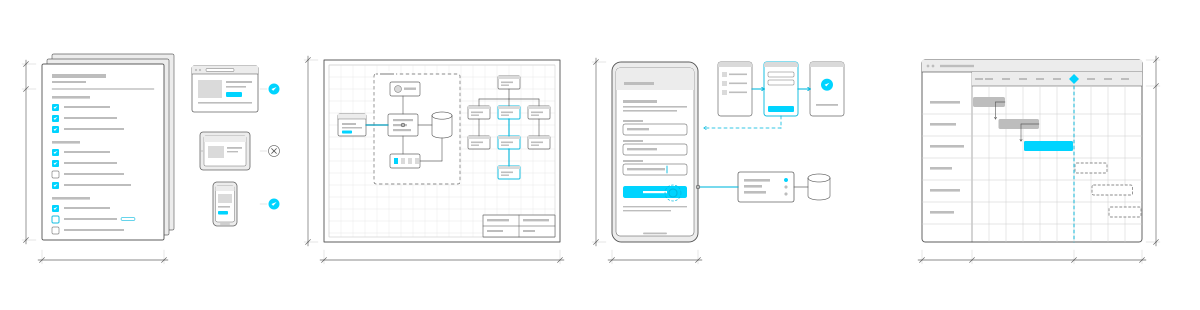
A working prototype first, and the build carries on from it.
ScopeBlueprintPrototypePlan
What we do
Software consulting, from a first conversation to a prototype you can use.
This is the first step of every project we build. You can also hire it on its own, at a fixed price, and keep what comes out of it whoever builds the rest.
-
Scoping
What the software has to do, who uses it, where it runs and what it connects to, worked out with you and written down before anything is built.
-
The blueprint
A written plan of what to build: the architecture, the list of screens or pages, and what each one does. Yours to keep, whoever builds it.
-
A working prototype
Real, working software for the main path, not a clickable mock-up. When the project goes ahead, the build continues from it instead of starting again.
-
Technical advice
Help choosing platforms and technology: web or app, native or cross-platform, and where it should be hosted. A second read of a plan or a vendor proposal before you sign it.
-
Review of your current system
A review of your current app or website and what it has to do now, with a plan to upgrade it or move to something newer one piece at a time.
-
The first step of a build
If the project goes ahead with us, the blueprint becomes the scope and the prototype becomes the first part of the build, whether that is a web app, a mobile or desktop app, or both.
Two ways in
A new idea, or an old system to replace.
Most consulting starts with one of these. Either way you end up with a blueprint and, where it helps, a working prototype, and then you decide what happens next.
Route 1 · New idea
Something new you want to build
For an idea that isn't a project yet. We scope it with you, write the blueprint with its architecture and screen list, and build a working prototype of the main path. Then you commit to the full build, with us or elsewhere, knowing what it is and what it will take.
- Scope worked out with you
- A written blueprint: architecture and screens
- A working prototype of the main path
- Advice on platforms and technology
Scope a new idea →
Route 2 · Existing system
An app or website that needs to change
For a site or app that has to keep running while it changes. We review what it does today, what it has to do now and what it connects to, then plan how to upgrade it or move to something newer one piece at a time.
- A review of the current site or app
- What it has to do now, written down
- A plan to upgrade, or to move step by step
- What content and data has to move across
Ask for a system review →
How it runs
Scope, blueprint, prototype, then decide.
We usually prototype on our designEdit framework, so an idea is working quickly, and sometimes it already does most of what you need. If the project calls for something else, we prototype in that.
-
1
Scope
What the software has to do, who uses it, what data it holds and what it connects to. For an existing system, what it does today and what has to change.
-
2
Blueprint
The written plan: the architecture, the list of screens or pages and what each one does, and the platforms and technology we recommend, with the reasons.
-
3
Prototype
A working version of the main path, so the plan is tried on something real, and the build can carry on from it.
-
4
Decide
You have the blueprint and the prototype. Go ahead with us, take them to another team, or stop there. Either way the full build starts from a plan.
Start where you are. If you already have a scope, a plan or a prototype from someone else, we review it with you and pick up from there instead of starting again. Tell us what you have.
Where this has worked
Prototypes that became products.
- Retail and telecom
- Rogers Marketing Central
- The dealer ad builder started from our blueprint and prototype, and the build grew from it: dealers pick a layout, an offer and the content, and download a print-ready ad.
- Audio production
- Vapor Music
- The internal music library started from our blueprint and prototype: search and filters by artist, genre, mood and instrument, with playlists for client presentations.
- Software products
- designEdit
- Our own framework for building business software. A blueprint file describes a record once, and the screens and the API come from it, which is how a prototype is built quickly and carries on into the product.
Client names are used with permission. Rogers is a trademark of its owner.
Questions
What clients ask before a blueprint and prototype.
Is the prototype thrown away?
Usually not. It's working software, often built on designEdit, so when the project goes ahead the build carries on from it. Sometimes the prototype already does most of what you wanted, and there is less left to build. If a prototype is only for testing an idea, we'll tell you before we start.
What does it cost?
The scope, blueprint and prototype have a fixed price, agreed with you before we start. It depends on how much the product has to do, so we work it out after a first conversation.
What do we get at the end?
A written blueprint with the architecture, the screens or pages and what each one does, the platforms we recommend and why, a working prototype of the main path, and a price for the full build.
Do we have to build with you afterwards?
No. You keep the blueprint and the prototype and can take them to another team. If the prototype is built on designEdit, we work with you to choose the licence model that fits.
Can you review a proposal from another vendor?
Yes. We read the plan or proposal, tell you what's missing or risky, and what we'd ask before signing.
Can you review a system we already have?
Yes. We look at what it does today, what it has to do now and what it connects to, then plan how to upgrade it or replace it in stages.
Do we need designers for the prototype?
No. The prototype is about how it works, not how it looks. A prototype built on designEdit already has a clean, consistent interface, and for some projects, such as internal tools, that is all the design it needs. When it needs more, designers come in after it, your own or a design firm that fits the project.